

Noise modelling
You can place an order:
- by phone: + 370 670 75 215
- by email: info@tyrimulaboratorija.lt
- in person: Guobų aklg. 1i, Kretinga, Klaipėda County
Noise modelling is an advanced acoustic calculation method that predicts how noise will spread in the environment, assesses the impact of planned or existing activities and helps select the most effective noise reduction measures before design decisions are made.
Today noise modelling is an integral part of spatial planning, industrial facility design, transport infrastructure development and environmental impact assessment. Properly performed modelling shows whether a future activity will comply with Lithuanian hygiene standards and helps avoid costly design changes at later stages.
From €400 per project — the final price depends on the complexity of the site, the number of noise sources and the scope of analysis required
Customer reviews of our noise modelling
Reviews from rekvizitai.lt, translated from Lithuanian.
We ordered modelling of railway noise. The work was completed on schedule, and the team professionally helped us resolve complex issues related to railway requirements. Recommended!
A professional team that works precisely and keeps to agreed deadlines. They provided thorough, clear test data and detailed noise modelling results. Recommended.
Why choose UAB Tyrimų laboratorija for noise modelling?
Our team has up to 20 years of experience in noise studies and modelling. We have completed some of the most complex and unique projects in Lithuania – including projects that other providers were unable to deliver.
We stand out not only for our expertise but also for our technical capabilities: our modelling results are additionally refined with an acoustic camera, and the studies are based on long-term monitoring. We apply a unique methodology refined over many years that achieves a level of accuracy most providers simply do not reach. That is why the noise mitigation solutions we propose go beyond standard noise barriers.
We are recognised as experts and leaders in noise research – we take part in meetings on amending hygiene standards and laws regulating noise, contributing to the improvement of legislation in Lithuania.
What is noise modelling?
Noise modelling is a process based on mathematical and physical calculation methods that determines how sound propagates in the environment.
Unlike spot noise measurements, modelling assesses not only the current situation but also predicts future noise conditions.
After the assessment we prepare clear conclusions, calculation justifications and all the necessary documentation – suitable for environmental impact assessment (EIA), public health impact assessment and IPPC permit documents, for obtaining pollution permits, or for agreeing design solutions with the responsible authorities.
Factors taken into account in modelling
- sound power levels, heights and locations of noise sources;
- terrain, buildings and their screening effect;
- vegetation and ground surface properties;
- meteorological conditions and traffic flows;
- operating modes and day, evening and night periods.
When is noise modelling needed?
Noise modelling is needed whenever a new activity is planned or existing infrastructure is changed and the potential noise impact on the environment must be assessed.
- designing factories and industrial facilities;
- designing logistics centres and warehouses;
- building shopping centres and car parks;
- preparing spatial planning, EIA and public health impact assessment documents, and IPPC permits;
- designing wind farms;
- designing road and railway infrastructure;
- investigating residents' complaints;
- planning noise reduction measures.
Our acoustic calculations
Noise modelling for industry
For factories, logistics centres, quarries, wastewater treatment plants and energy facilities. We assess equipment loads and production scenarios.
Examples from our industrial projects
First a 3D model of the industrial site is built, then the noise propagation around it is calculated and visualised:

1. 3D (isometric) model of an industrial site used in noise calculations

2. Noise map of the same site with noise contours

Noise source identification with an acoustic camera
In complex industrial environments with several noise sources, an acoustic camera makes it possible to identify visually and precisely which specific piece of equipment or component produces the most noise.
Road traffic noise modelling
Calculations of road traffic noise propagation, taking into account traffic volume, speed, road surface type, terrain and the effectiveness of noise barriers. Used when planning new roads and assessing the impact of existing infrastructure on residential areas.

Detailed noise level (dB) modelling around a road, taking terrain and surrounding buildings into account
Another example of noise modelling on a road section next to a residential area:

Noise propagation modelling along a residential section
Railway noise modelling
Calculations of noise propagation around railway infrastructure, based on train traffic volume, speed and track condition.
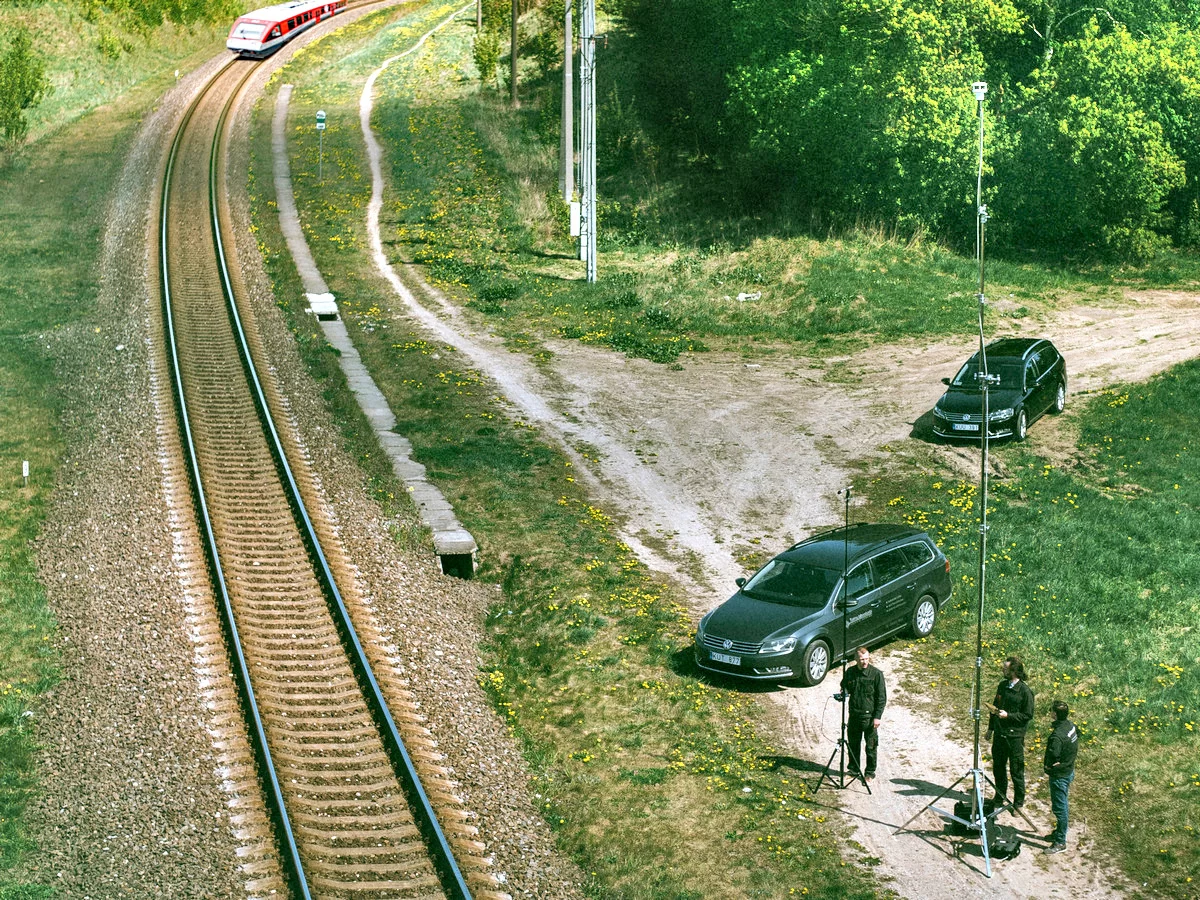
Railway noise measurements

Railway noise propagation modelling

Vertical cross-section of noise propagation
Building acoustic calculations at the design stage
Determination of façade sound class, and calculations of airborne and impact sound insulation of building elements.

Façade sound class determination – noise level (dB) distribution at the building

Cross-sections showing noise propagation, taking terrain and noise barriers into account
Wind turbine noise modelling
Assessment of the acoustic parameters of wind farms and their combined impact on residential areas. We carry out specialised analyses that take into account the specific nature of wind turbine noise – low-frequency sound, blade rotation periodicity and the seasonal influence of wind on noise propagation.
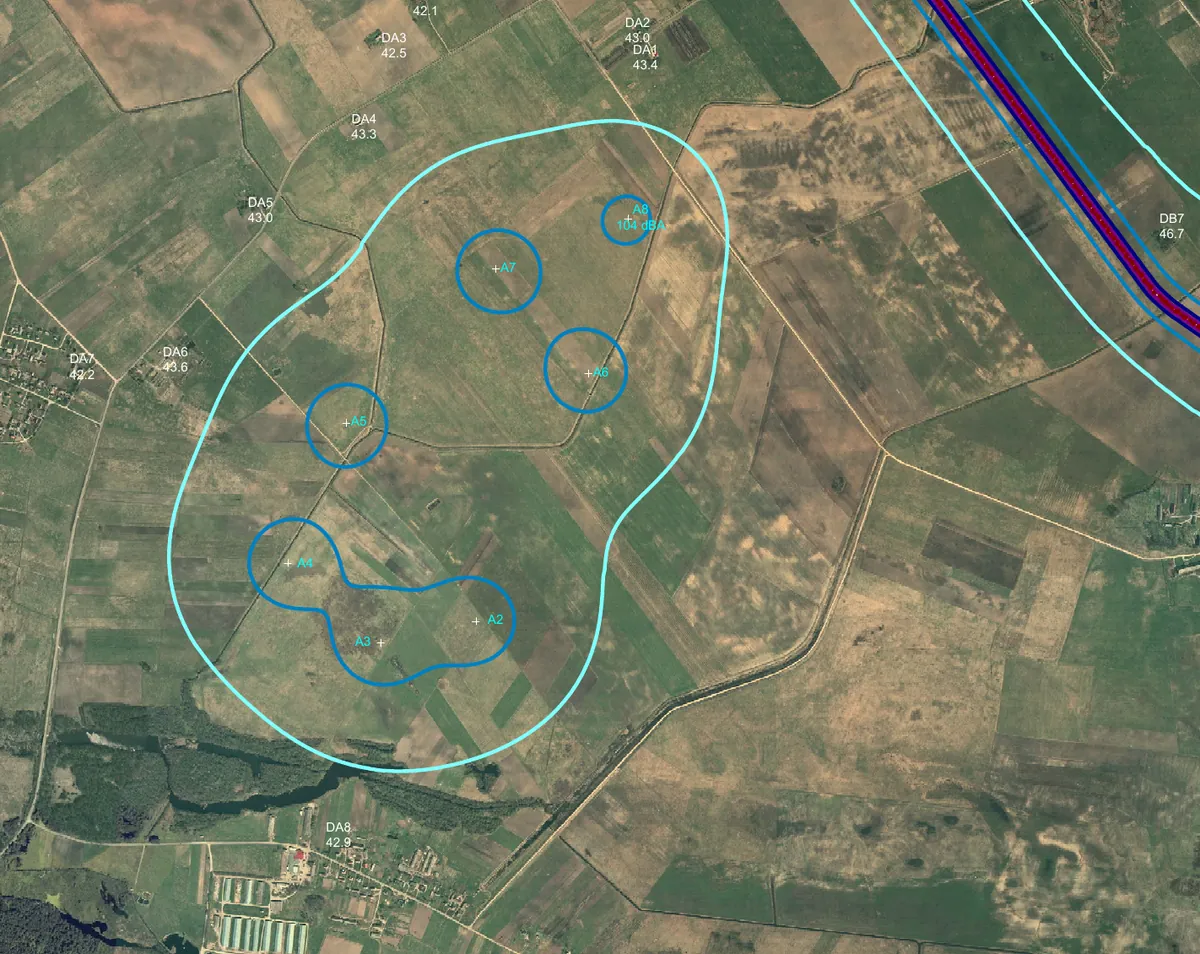
Wind farm noise propagation modelling
Building services noise modelling
Calculations of noise from building services equipment – ventilation and air conditioning systems, heat pumps, generators, lifts and other noisy equipment. We assess whether the equipment will comply with hygiene standards in surrounding buildings and rooms before it is installed.
FAQ (Frequently asked questions)
Prices start from €400 per project. The final price depends on the complexity of the site, the number of noise sources, the size of the area and the scope of analysis required.
Noise measurement records the existing, actual noise level at a specific moment. Noise modelling, by contrast, uses mathematical calculations to predict noise propagation — both current and future — before design solutions are implemented.
Usually we need site plans or topographic data, information about noise sources (equipment sound power levels, operating mode), the layout of surrounding buildings and, if available, results of existing noise measurements. When you contact us, we will determine exactly which data your project requires.
It depends on the scope of the project and how complex the data collection is. Simpler projects can take a few days, while larger industrial or spatial planning projects can take several weeks.
In most cases where a planned activity may have a significant noise impact on the environment, noise modelling is a required part of the environmental impact assessment (EIA) or the public health impact assessment of the planned economic activity. We recommend confirming the requirements for each specific project.
Yes, we can additionally use an acoustic camera, which visually identifies dominant noise sources in complex industrial or urban environments. This refines the modelling results beyond what mathematical calculations alone can achieve. More about acoustic camera surveys.
Contact us — we will assess your situation, discuss the input data needed and propose the most suitable testing and modelling solution.
- by phone: + 370 670 75 215
- by email: info@tyrimulaboratorija.lt
- in person: Guobų aklg. 1i, Kretinga, Klaipėda County