

Indoor environment measurements
Artificial and natural lighting, indoor microclimate measurements
We assess the lighting and thermal environment of workplaces, residential and public buildings.
Measurements are carried out using accredited methods in accordance with the applicable Lithuanian hygiene standards.
Lighting measurements
We assess natural and artificial lighting levels at workplaces and in residential and public buildings according to EN 12464-1:2021, EN 12464-2:2025 and the Lithuanian hygiene standard HN 98:2014. We carry out the following types of lighting measurements:
- General and workplace lighting – illuminance (lux) and daylight factor measurements on work surfaces and in general areas;
- Emergency lighting – testing of escape and standby lighting levels according to EN 1838:2025 to ensure safe evacuation if the main power supply fails;
- Outdoor lighting – illuminance measurements of sites, yards and outdoor luminaires.
Microclimate measurements
We measure indoor air temperature, relative humidity and air velocity according to the Lithuanian hygiene standards HN 69:2003 and HN 42:2009 – the key microclimate parameters affecting the comfort and health of employees and residents.
Ventilation airflow measurements
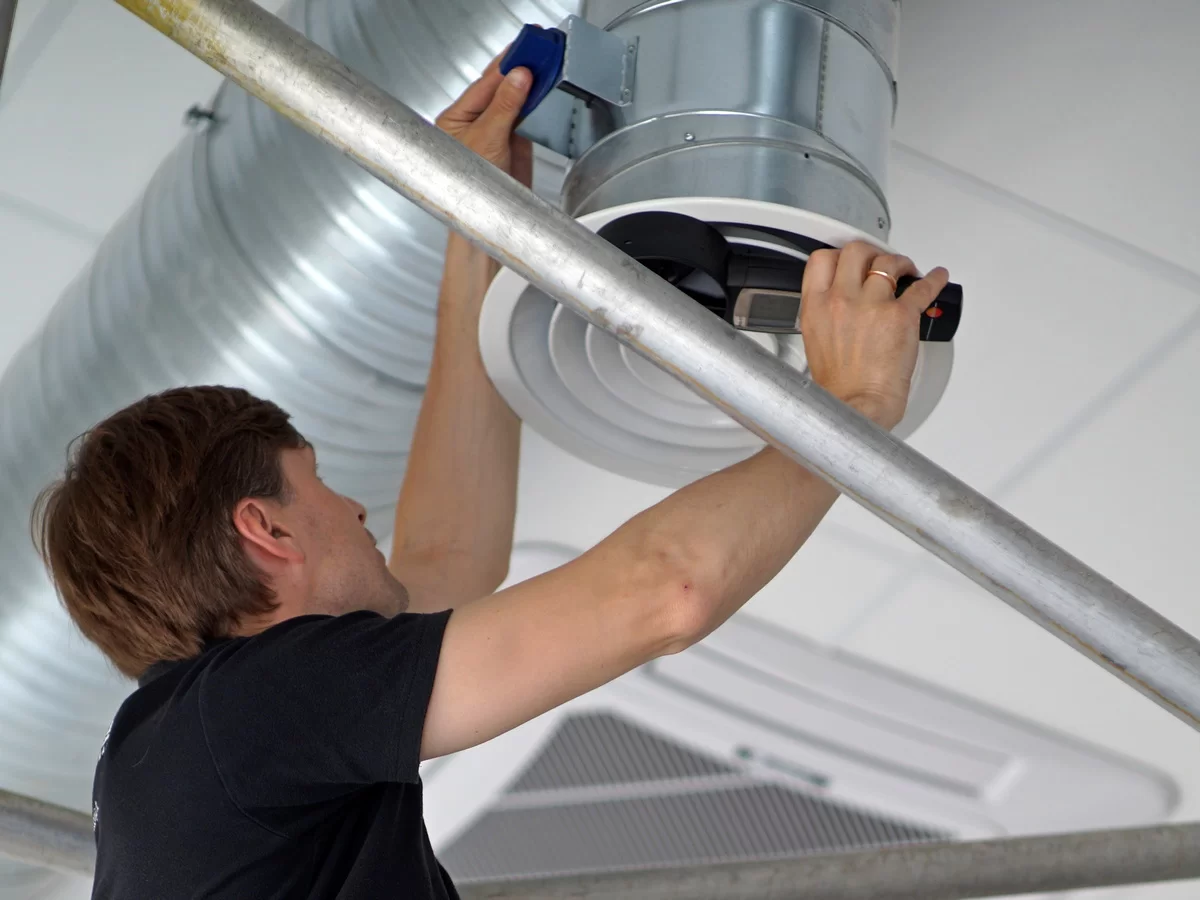
We determine the exact airflow rates at each ventilation terminal according to EN 12599:2013 and issue a ventilation certificate (commissioning record). These measurements are not within the formal scope of our accreditation, but are carried out in full compliance with the EN ISO/IEC 17025 quality management requirements.
Water temperature measurements
We measure hot and cold water temperatures in water supply systems according to the Lithuanian hygiene standard HN 24:2003. These measurements are not within the formal scope of our accreditation, but are carried out in full compliance with the EN ISO/IEC 17025 quality management requirements.
Vibration measurements
We assess vibration (acceleration, velocity) at workplaces and in residential premises according to ISO 2631-1 to determine compliance with hygiene limit values. These measurements are not within the formal scope of our accreditation, but are carried out in full compliance with the EN ISO/IEC 17025 quality management requirements.
FAQ (Frequently asked questions)
Yes. Outdoor lighting measurements are carried out in the dark so that natural daylight does not distort the results and only the artificial lighting level can be assessed objectively.
Yes, unless the rooms have no windows. If a room has windows, daylight can distort the emergency lighting results, so the measurement is taken in the dark. In windowless rooms the test can be done at any time of day by simply switching off the main lighting.
Lighting measurements are needed when new or reconstructed buildings are handed over, when checking workplace compliance with occupational health and safety requirements, and when there are doubts about whether existing lighting is sufficient in workplaces, residential or public premises.
A ventilation certificate is a document recording the measured airflow rates of the ventilation system at each ventilation terminal. It is usually needed when a building is handed over, to confirm that the installed ventilation system actually delivers the airflows specified in the design.
Yes. We can measure the ventilation system airflows and check whether the actual airflows at each point in the room meet the design values and the standards set by legislation. If there is not enough air, the measurements objectively show whether the problem is insufficient system capacity, incorrect balancing or blocked ducts – and provide a basis for asking the installer to fix the defects.
Yes. Airflow measurements at each ventilation terminal show whether the system actually works as designed. Unbalanced, too weak or too strong airflows, or an uneven distribution between rooms, often indicate installation errors (incorrect balancing, leaky or squeezed ducts, etc.). This makes it possible to objectively assess the installation quality before the building is handed over.
We measure indoor air temperature, relative humidity and air velocity. These parameters are assessed against the limit values of the applicable hygiene standards, depending on the purpose of the room.
Water temperature measurements check whether the hot and cold water temperatures in the water supply system meet hygiene requirements – important both for residents' comfort and for preventing bacterial growth in the water system.
Vibration measurements are needed at workplaces with vibrating equipment or machinery, and when residents complain about vibration felt in a building, to determine compliance with hygiene limit values.
A test report is issued with the results and an assessment of whether they meet the applicable hygiene standards.
Yes. We also measure lighting uniformity – how evenly the illuminance is distributed over a work surface or room, which is particularly important for workplace lighting under EN 12464-1:2021.